
Thursday, July 5, 2012

Lac Rose in Senegal
This is a series of photographs of Lake Retba in Senegal. It's pink. The lake has an unusually high salt concentration (like the Dead Sea), in which Dunaliella salina micro-algae thrive, giving it its pink hue.


Sunday, July 1, 2012
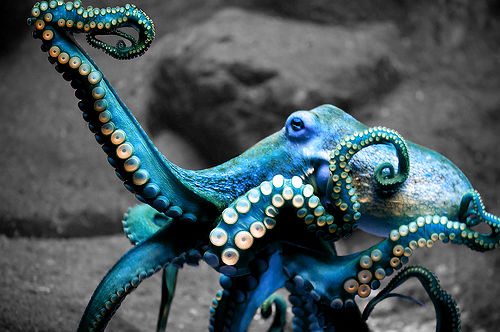
Baby Octopi
"Shortly after being put on exhibit at the California Academy of Sciences, this Caribbean Octopus vulgaris took up residence inside a glass bottle, on full view for adoring fans. Just as quickly, it moved back under a rock and started denning, and laying eggs. While eggs being laid in captivity is generally an exciting event, this particular species, like many but not all octopus, stops eating after it lays eggs and dies soon after they hatch which tends to put a damper on the joyous occasion. The biologist responsible for their care, Richard Ross, caught the hatching of the eggs from start to finish on film, and describes it as a waterfall flowing upwards toward the water's surface. Now, Ross faces the difficult task of trying to support thousands of tiny hatchlings. This species is "small egged" meaning it produces large numbers of very small planktonic 'paralarvae' which are notoriously difficult to feed and raise. The adult female and hatchlings will be on display for as long as possible in the Staff Picks area of Steinhart Aquarium at the California Academy of Sciences." From www.zooborns.com
Friday, June 29, 2012


Wednesday, June 27, 2012
Mind-control Fungus

A stalk of the new fungus species Ophiocordyceps camponoti-balzani grows out of a "zombie" ant's head in a Brazilian rain forest. Originally thought to be a single species, called Ophiocordyceps unilateralis, the fungus is actually four distinct species—all of which can "mind control" ants, scientists announced in March. The fungus species can infect an ant producing compounds that affect the ant's brain and change its behaviour, and then kill the insect once the fungus moves to an ideal location for growing and spreading its spores.
Tuesday, June 26, 2012
Monday, June 25, 2012
"Higher funghi"

The Basidiomycota are one of two phyla of “higher fungi” - the other being the Ascomycota.
The primary differentiation between the two phyla is their method of reproduction.
What we call “mushrooms” are found in both phyla, with the Basidiomycota generally being more woody or leathery in texture, and the Ascomycota being more soft and fleshy. For example, species such as the chanterelles, shiitakes, giant puffballs, and sulfur shelf (chicken mushroom/Chicken of the Woods) are all Basidiomycotes. Morels and truffles are some Ascomycotes, along with many other interesting fungi, like Baker’s Yeast, the fungus that gave us penicillin, and the fungus that gives us blue cheeses.
Kunstformen der Natur [Plate 63]. Ernst Haeckel, 1904.
Tuesday, June 19, 2012
Internal Anatomy of the Grass Frog [Genus Litoria]

As different as frogs are from you and I, you can clearly see how
similar vertebrates are to each other when you dissect one. One heart,
two lungs, a stomach, liver, spleen, gall bladder, intestines, kidneys,
bladder, and gonads are visible in this particular dissection, as well
as the extraordinarily strong leg muscles.
Brehms Tierleben, Bd. 1. Alfred Brehms, 1911.
Monday, June 18, 2012
Ornithorhynchus Anatinus (Platypus)

"The platypus (Ornithorhynchus anatinus) is a semi-aquatic mammal endemic to eastern Australia, including Tasmania. Together with the four species of echidna, it is one of the five extant species of monotremes, the only mammals that lay eggs instead of giving birth to live young. The unusual appearance of this egg-laying, venomous, duck-billed, beaver-tailed, otter-footed mammal baffled European naturalists when they first encountered it, with some considering it an elaborate fraud.
It is one of the few venomous mammals, the male platypus having a spur on the hind foot that delivers a venom capable of causing severe pain to humans. While both male and female platypuses are born with ankle spurs, only the male has spurs which produce a cocktail of venom,composed largely of defensin-like proteins (DLPs), three of which are unique to the platypus. The defensin proteins are produced by the immune system of the platypus. Although powerful enough to kill smaller animals such as dogs, the venom is not lethal to humans, but the pain is so excruciating that the victim may be incapacitated.
Since only males produce venom and production rises during the breeding season, it may be used as an offensive weapon to assert dominance during this period."
From: http://en.wikipedia.org/wiki/Platypus
Sunday, June 17, 2012

Wednesday, June 13, 2012


Wednesday, June 6, 2012
Venus Transit 6.6.12
"A transit of Venus across the Sun takes place when the planet Venus passes directly between the Sun and Earth (or another planet), becoming visible against (and hence obscuring a small portion of) the solar disk. During a transit, Venus can be seen from Earth as a small black disk moving across the face of the Sun. The duration of such transits is usually measured in hours (the transit of 2012 lasted 6 hours and 40 minutes). A transit is similar to a solar eclipse by the Moon. While the diameter of Venus is more than 3 times that of the Moon, Venus appears smaller, and travels more slowly across the face of the Sun, because it is much farther away from Earth."


Subscribe to:
Posts (Atom)