Showing posts with label illustration. Show all posts

Wednesday, December 26, 2012

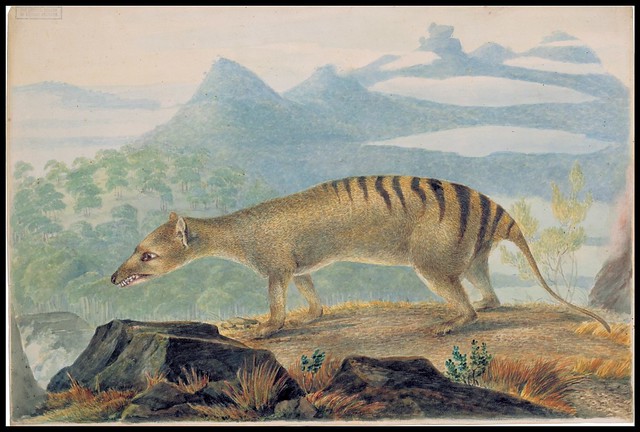
Tasmanian Tiger


 Thylacinus cynocephalus, Greek for "dog-headed pouched one", was the largest
 known carnivorous marsupial of modern times. It is commonly known as the
Tasmanian tiger (because of its striped back) or the Tasmanian wolf. Native to
continental Australia, Tasmania and New Guinea, it is thought to have become
extinct in the 20th century. It was the last extant member of its family, Thylacinidae;
specimens of other members of the family have been found in the fossil record
dating back to the early Miocene.

Despite its official classification as extinct, sightings are still reported, though none
has been conclusively proven. The thylacine was one of only two marsupials to have
a pouch in both sexes (the other being the water opossum). The male thylacine had
a pouch that acted as a protective sheath, covering the male's external reproductive
organs while he ran through thick brush. It has been described as a formidable predator
because of its ability to survive and hunt prey in extremely sparsely populated areas.
 
Source: http://en.wikipedia.org/wiki/Thylacine

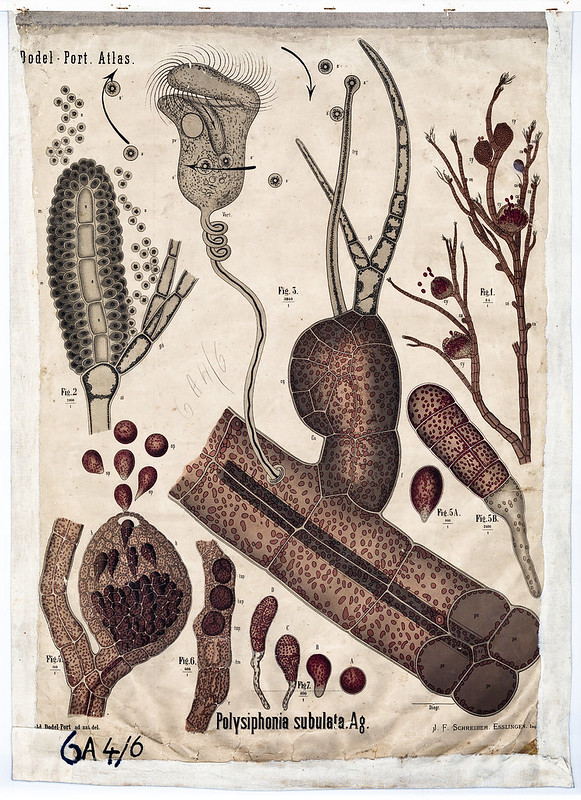
Plant Systematics Wall Chart Circa 1878


Polysiphonia Subulata (red algae genus)

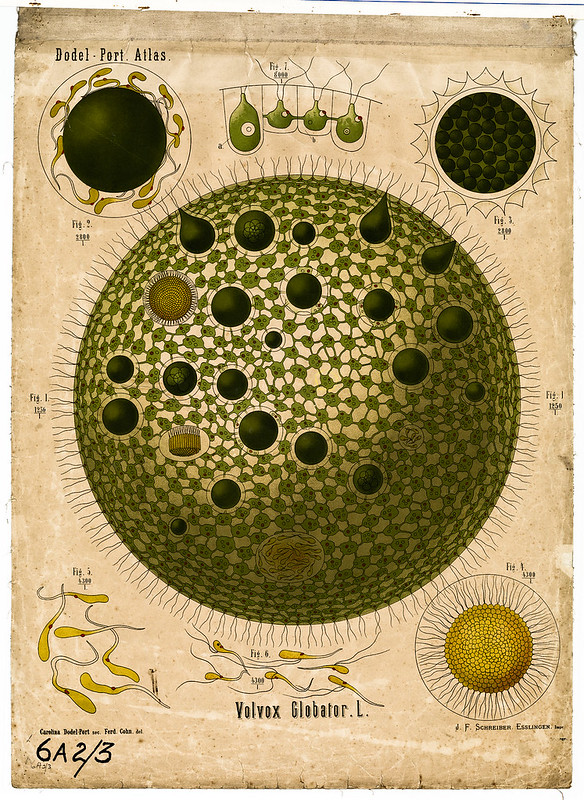
This shows the freshwater green alga Volvox globator. Many individual cells
 live together forming a beautiful spherical colony. Some of them are specialized
for reproduction.

"Living nature is the best teacher and pedagogue; an artistic medium of
representation tries to replace nature and this can be possible in practice only
 if the images are true to natural objects."

Source: http://bibliodyssey.blogspot.com/

Monday, June 25, 2012

"Higher funghi"


The Basidiomycota are one of two phyla of “higher fungi” - the other being the Ascomycota.
The primary differentiation between the two phyla is their method of reproduction.

What we call “mushrooms” are found in both phyla, with the Basidiomycota generally being more woody or leathery in texture, and the Ascomycota being more soft and fleshy. For example, species such as the chanterelles, shiitakes, giant puffballs, and sulfur shelf (chicken mushroom/Chicken of the Woods) are all Basidiomycotes. Morels and truffles are some Ascomycotes, along with many other interesting fungi, like Baker’s Yeast, the fungus that gave us penicillin, and the fungus that gives us blue cheeses.
Kunstformen der Natur [Plate 63]. Ernst Haeckel, 1904.

Friday, April 27, 2012

Thursday, April 26, 2012

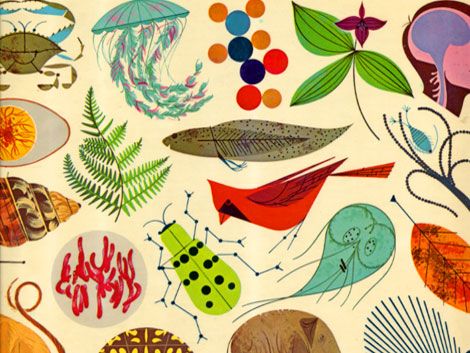
Charley Harper 1922-2007


In a style he called ‘minimal realism’, Charley Harper captured the essence of his subjects with the fewest possible visual elements. When asked to describe his unique visual style, Charley responded: “When I look at a wildlife or nature subject, I don’t see the feathers in the wings, I just count the wings. I see exciting shapes, color combinations, patterns, textures, fascinating behavior and endless possibilities for making interesting pictures. I regard the picture as an ecosystem in which all the elements are interrelated, interdependent, perfectly balanced, without trimming or unutilized parts; and herein lies the lure of painting; in a world of chaos, the picture is one small rectangle in which the artist can create an ordered universe.” (via Wikipedia)