Showing posts with label plant. Show all posts

Sunday, February 3, 2013

Worlds Shiniest Living Thing


These Pollia condensata berries are so colorful that they might have been picked
minutes ago. In fact, they were gathered in 1974. Found deep in the Ghana forest,
this tropical metre-tall herb sprouts its shiny berry-like fruits in clusters up to
40-strong. These little orbs are iridescent – they use special layers of cells, arranged
just so, to reflect colours with extraordinary intensity. This trick relies on the micro-
scopic physical structures of the cells, rather than on any chemical pigments. Indeed,
the fruits have no blue pigment at all. Like beetles and butterflies the color does not
degrade over time. Researchers say that P. condensata's blue is the most intense color
in the natural world.

Source: www.wired.com/best-science-imges-2012

Friday, December 28, 2012


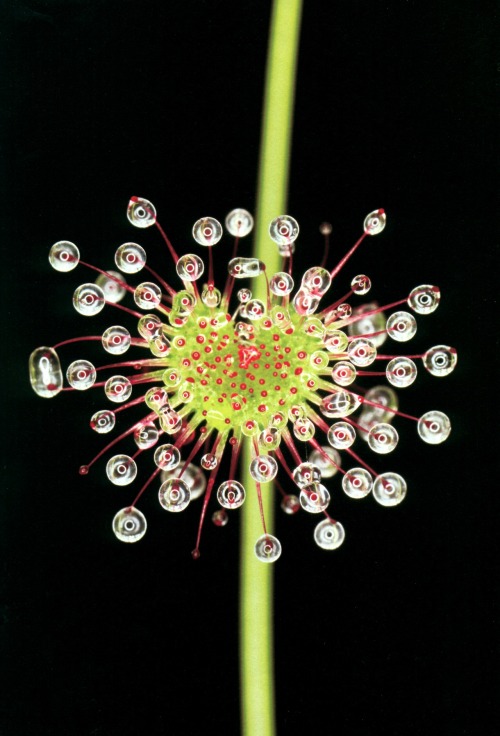
The Australian sundew plant uses its sticky “dewdrops” to attract and trap the
insects that are its food.

Photo by Helene Schmitz, March 2010 National Geographic

Wednesday, December 26, 2012

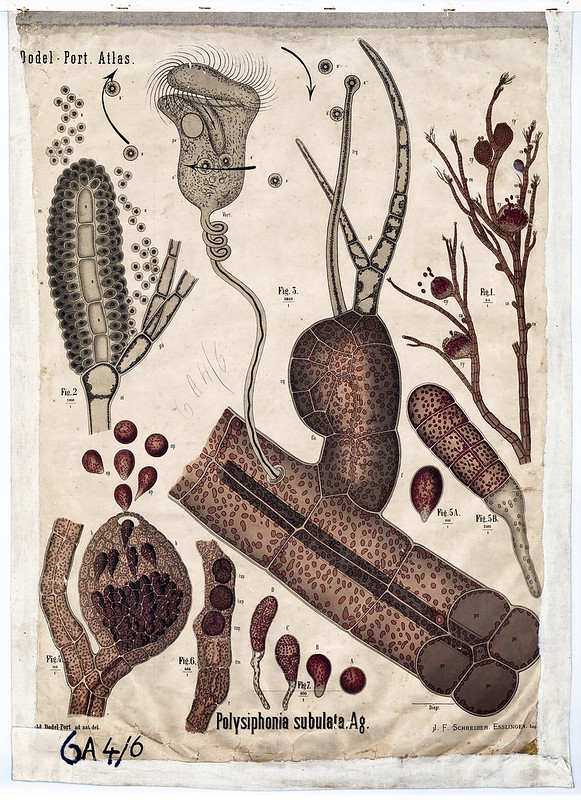
Plant Systematics Wall Chart Circa 1878


Polysiphonia Subulata (red algae genus)

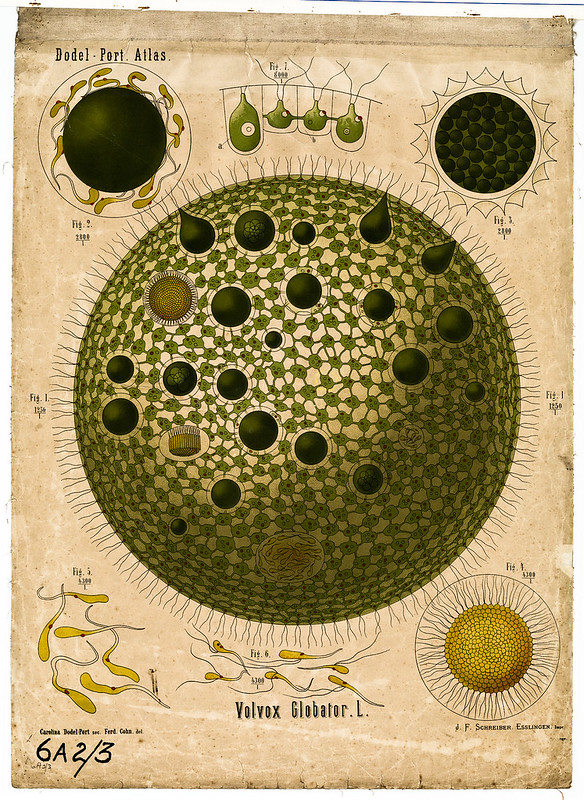
This shows the freshwater green alga Volvox globator. Many individual cells
 live together forming a beautiful spherical colony. Some of them are specialized
for reproduction.

"Living nature is the best teacher and pedagogue; an artistic medium of
representation tries to replace nature and this can be possible in practice only
 if the images are true to natural objects."

Source: http://bibliodyssey.blogspot.com/

Tuesday, November 13, 2012

Monday, September 24, 2012

Bleeding Tooth Fungus


The Bleeding Tooth fungus, or Hydnellum pecki, is found in pine forests of the
American Pacific northwest and central Europe. It's also known by the names
'Devil's Tooth' or 'Strawberries and Creme'. Ironically, their oozing 'blood' actually
contains an anticoagulant called atromentrin.

Tuesday, September 11, 2012

Wooly Bat and Carnivorous Plant Sybiosis


Professor Ulmar Grafe noticed that Hardwicke's woolly bats were regularly roosting in Nepenthes hemsleyana pitcher plants in Brunei (on the tropical island of Borneo).

 The benefits for the bats appears quite obvious, as this particular species of pitcher plant has a very low level of digestive fluid, meaning the bats can safely roost in an environment sheltered from predators and without fear of being eaten by enzymes.

Pitcher plants typically grow in areas where the soil is very nitrogen depleted, hence their reliance on a carnivorous life style.

Under further investigation Grafe found that the plants gained 33% of their nitrogen not from feeding on insects but from the droppings of the bats, showing strong evidence for an intriguing case of mutualism.

Source: Bat Conservation Intnl website www.batcon.org

Monday, June 25, 2012

"Higher funghi"


The Basidiomycota are one of two phyla of “higher fungi” - the other being the Ascomycota.
The primary differentiation between the two phyla is their method of reproduction.

What we call “mushrooms” are found in both phyla, with the Basidiomycota generally being more woody or leathery in texture, and the Ascomycota being more soft and fleshy. For example, species such as the chanterelles, shiitakes, giant puffballs, and sulfur shelf (chicken mushroom/Chicken of the Woods) are all Basidiomycotes. Morels and truffles are some Ascomycotes, along with many other interesting fungi, like Baker’s Yeast, the fungus that gave us penicillin, and the fungus that gives us blue cheeses.
Kunstformen der Natur [Plate 63]. Ernst Haeckel, 1904.