Showing posts with label animal. Show all posts

Thursday, July 25, 2013

The Whole 2-Yards: Giraffe Neck Growth Patterns


The giraffe’s neck actually contains the same number of cervical (neck) vertebrae
found in nearly all other mammals. (For a discussion of the very few mammals
to deviate the magic number of seven cervicals, see this Endless Forms post).
The rate at which these vertebrae develop relative to other parts of the giraffe’s
body, including its head and overall body mass, however, has not been adequately
explored.

More at: www.scilogs.com/endless_forms

Nat Geo Amatuer Photo Contest Winner


Overall winner of the National Geographic Best Underwater Pictures 2013.
Check out the runner-ups here: Nationalgeographic.com/contest

Wednesday, May 29, 2013

Tuesday, May 21, 2013

Phantom Limbs


Salamanders can grow back lost limbs, and scientists have now discovered
that immune cells are the key to this regeneration, taking us a step closer to being
able to heal human tissue in the same way. The researchers found that cells known
as macrophages are crucial to the salamanders' unique healing abilities, and could
one day help treat spinal cord and brain injuries in humans.

More here: www.sciencealert.com

Monday, March 11, 2013

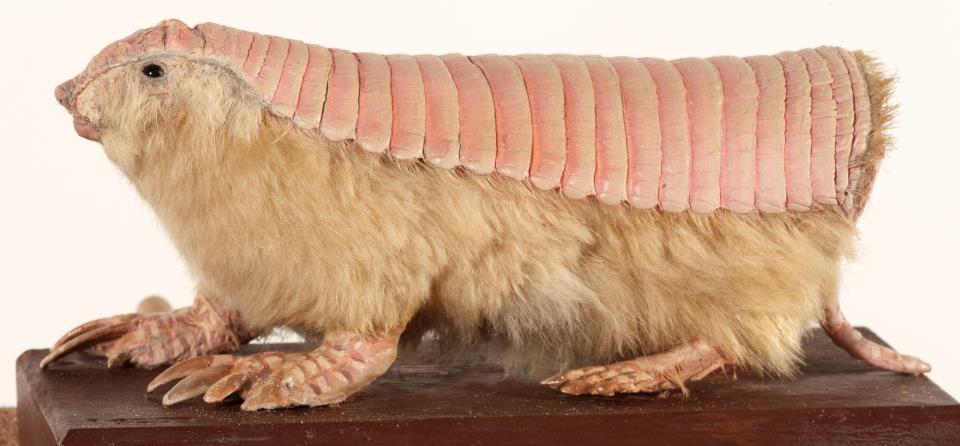
Pink Fairy Armadillo

 
The pink fairy armadillo (Chlamyphorus truncatus) or pichiciego is the smallest species of armadillo (mammals of the family Dasypodidae, mostly known for having a bony armor shell). It is found in central Argentina, where it inhabits dry grasslands and sandy plains with thorn bushes and cacti.

It is a nocturnal animal. It burrows small holes near ant colonies in dry soil, and feeds mainly on ants and ant larvae near its burrow. Occasionally, it feeds on worms, snails, insects and larvae, or various plant and root material.

The pink fairy armadillo spends much of its time under the ground, as it is a "sand swimmer" similar to the golden mole or the marsupial mole. It uses large front claws to agitate the sand, allowing it to almost swim through the ground like it is water. It is torpedo-shaped, and has a shielded head and back.

Source: wikipedia.com

Sunday, March 10, 2013

Thursday, February 7, 2013

Friday, February 1, 2013

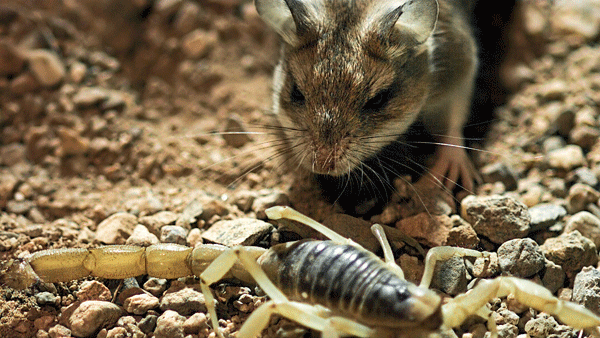
Carnivorous Grasshopper Mouse


 It's the southern grasshopper mouse (Onychomys torridus), the only carnivorous
mouse in North America. Its unique biology and resistance to scorpion venom
may one day help researchers treat human pain disorders. But for now, it's just after blood.
Its behavior is rather distinct from other mice. It is a carnivorous rodent, dining
on insects (such as grasshoppers), worms, scorpions, snakes, and even other mice.
It also stalks its prey in the manner of a cat sneaking up quietly, and defends its
territory by "howling" like a small wolf.

Source: www.newscientist.com

Monday, January 28, 2013

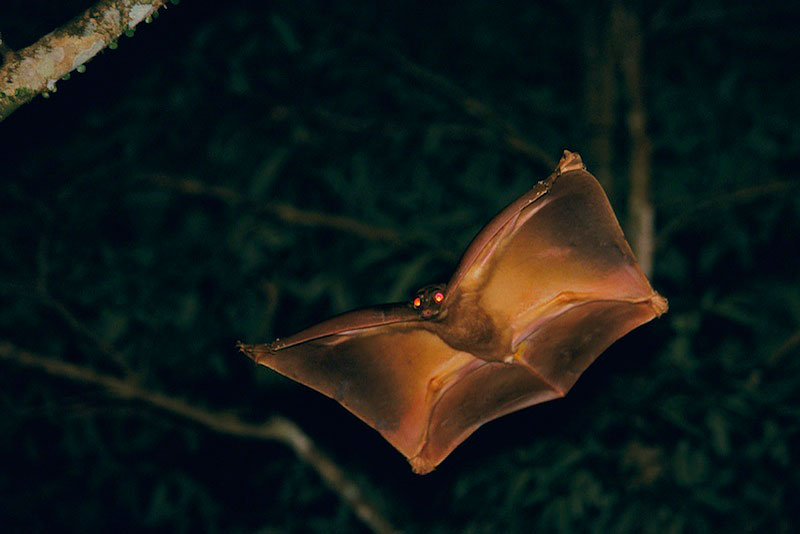
Colugos


Colugos are arboreal gliding mammals found in South-east Asia. There are just
two extant species, which make up the entire family Cynocephalidae and order
Dermoptera. They are the most capable of all gliding mammals, using flaps of
extra skin between their legs to glide from higher to lower locations.
They are also known as cobegos or flying lemurs, though they are not true lemurs.

Colugos were traditionally considered being close to the ancestors of bats, but
are now seen by some as the closest living relatives to primates. 

Friday, January 18, 2013

Wednesday, January 2, 2013

A Star-Nosed Mole’s Nose


The star-nosed mole is easily identified by the 11 pairs of pink fleshy
appendages ringing its snout, which is used as a touch organ with more
than 25,000 minute sensory receptors, known as Eimer's organs, with
which this hamster-sized mole feels its way around. With the help of
its Eimer's organs, it may be perfectly poised to detect seismic wave
vibrations. Because the star-nosed mole is functionally blind, the snout
was long suspected to be used to detect electrical activity in prey
animals, though little, if any, empirical support has been found for
this hypothesis.

These moles also possess the ability to smell underwater, accomplished
by exhaling air bubbles onto objects or scent trails and then inhaling the
bubbles to carry scents back through the nose.

Photo by Kenneth Catania, National Geographic, October 2009

Wednesday, December 26, 2012

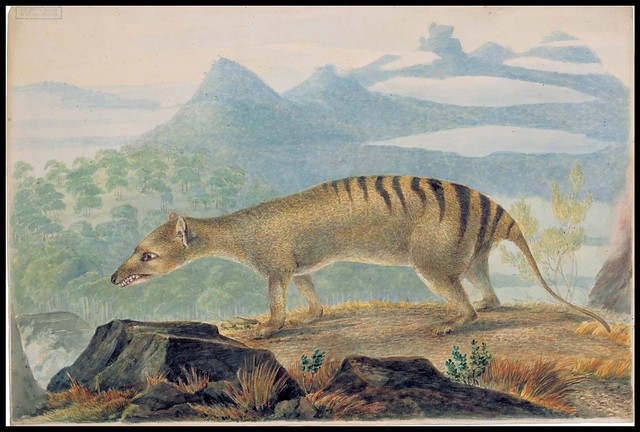
Tasmanian Tiger


 Thylacinus cynocephalus, Greek for "dog-headed pouched one", was the largest
 known carnivorous marsupial of modern times. It is commonly known as the
Tasmanian tiger (because of its striped back) or the Tasmanian wolf. Native to
continental Australia, Tasmania and New Guinea, it is thought to have become
extinct in the 20th century. It was the last extant member of its family, Thylacinidae;
specimens of other members of the family have been found in the fossil record
dating back to the early Miocene.

Despite its official classification as extinct, sightings are still reported, though none
has been conclusively proven. The thylacine was one of only two marsupials to have
a pouch in both sexes (the other being the water opossum). The male thylacine had
a pouch that acted as a protective sheath, covering the male's external reproductive
organs while he ran through thick brush. It has been described as a formidable predator
because of its ability to survive and hunt prey in extremely sparsely populated areas.
 
Source: http://en.wikipedia.org/wiki/Thylacine

Thursday, December 13, 2012


Perth Zoo has managed to breed two baby echidnas (known as puggles). Only
24 puggles have been successfully born in captivity, and these new-borns
represent the first successful breeding of zoo born echidnas. Breeding echnidnas
is notoriously difficult so the information gathered from these infants as they
grow will be vital in learning more about the reproduction of this species.

Thursday, November 29, 2012

Darwin’s Frog

Photobucket
The male Darwin’s frog broods tadpoles in its mouth. They tend to get frisky
as children often do. He carries them around until they develop into froglets
and hop out of his mouth.

Tuesday, November 27, 2012

Thursday, November 22, 2012

Tuesday, November 20, 2012

Willow the White Whale


 An extremely rare white humpback whale was spotted recently near Norway. 
Welsh maritime engineer Dan Fisher made the startling discovery off the coast
 of Norway in August.  Fisher has dubbed him Willow the White Whale. 

Website Life’s Little Mysteries states: this is only the second known adult white
 humpback whale on the planet. The first is Migaloo, a humpback who’s made 
numerous cameos off Australia’s east coast. The whale’s name means
 “white fella” in Aboriginal, and he’s usually spotted as he makes his annual 
migration to Antarctic waters during the southern spring. 

While Migaloo is thought to be affected by albinism, a genetic condition that 
stifles melanin pigmentation, it’s possible his Norwegian counterpart is not 
albino, but leucistic. Leucism can affect pigments other than melanin and it 
doesn’t result in the pink eyes characteristic of albinism. Leucism can also 
leave an animal with splotches of colour.

Source: Twisted Sifter

Monday, November 19, 2012

Proboscis Monkey


The proboscis monkey (Nasalis larvatus) or long-nosed monkey, known as the bekantan in Malay, is a reddish-brown arboreal Old World monkey that is endemic to the south-east Asian island of Borneo.

The monkey also goes by the Malay name monyet belanda ("Dutch monkey"), or even orang belanda ("Dutchman"), as Indonesians remarked that the Dutch colonisers often had a similarly large belly and nose.

Source: http://en.wikipedia.org/wiki/Proboscis_monkey

Tuesday, November 6, 2012