Showing posts with label facts. Show all posts

Thursday, July 25, 2013

The Whole 2-Yards: Giraffe Neck Growth Patterns


The giraffe’s neck actually contains the same number of cervical (neck) vertebrae
found in nearly all other mammals. (For a discussion of the very few mammals
to deviate the magic number of seven cervicals, see this Endless Forms post).
The rate at which these vertebrae develop relative to other parts of the giraffe’s
body, including its head and overall body mass, however, has not been adequately
explored.

More at: www.scilogs.com/endless_forms

Tuesday, May 21, 2013

Phantom Limbs


Salamanders can grow back lost limbs, and scientists have now discovered
that immune cells are the key to this regeneration, taking us a step closer to being
able to heal human tissue in the same way. The researchers found that cells known
as macrophages are crucial to the salamanders' unique healing abilities, and could
one day help treat spinal cord and brain injuries in humans.

More here: www.sciencealert.com

Thursday, March 7, 2013

Cordyceps Parasitic Fungus


This unfortunate arachnid is infected with Cordyceps, a parasitic fungus that
replaces its host's tissue with its own.

Cordyceps fungi invades its hosts (mainly arthropods), and its mycelium
eventually replaces the host's tissue. Once the arthropod is dead, cylindrical
or branching growths emerge from the creature's dead body. Some species
also have mind-control capabilities, convincing the host to travel to a place
where the fungus will find optimal growth conditions before the host dies.

Friday, February 1, 2013

Methane Trapped in Ice


Bubbles of methane trapped in frozen Abrams lake, Canada.

Photographer Fikret Onal explains, "The plants on the lake bed release methane
gas and methane gets frozen once coming close enough to much colder lake surface
and they keep stacking up below once the weather gets colder and colder during
the winter season."

Monday, January 28, 2013

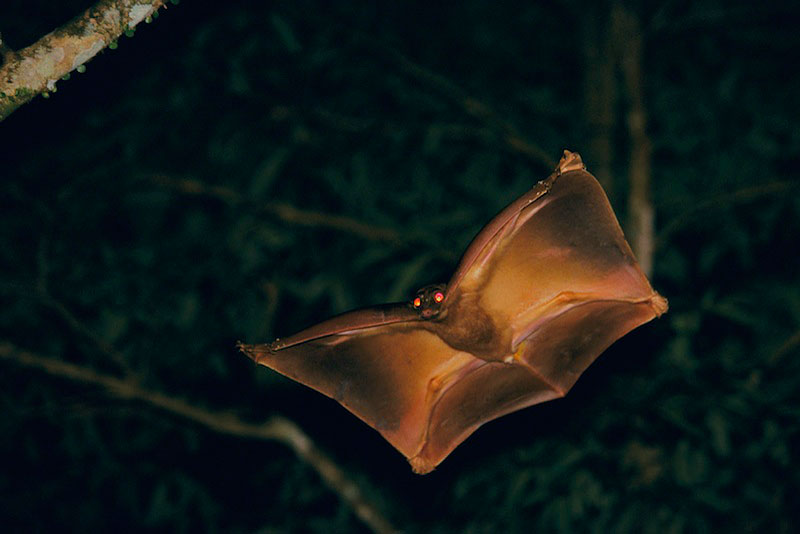
Colugos


Colugos are arboreal gliding mammals found in South-east Asia. There are just
two extant species, which make up the entire family Cynocephalidae and order
Dermoptera. They are the most capable of all gliding mammals, using flaps of
extra skin between their legs to glide from higher to lower locations.
They are also known as cobegos or flying lemurs, though they are not true lemurs.

Colugos were traditionally considered being close to the ancestors of bats, but
are now seen by some as the closest living relatives to primates. 

Pen-tailed Tree Shrew Likes the Sauce


Malaysia's pen-tailed tree shrew (above) regularly drinks fermented palm "beer,"
which in turn helps pollinate the palms' flowers, scientists reported in July 2008.

The pen-tailed tree shrew is the first non-human mammal known to display
alcoholic behavior. What's more, the rat-size animal never gets drunk during
its nonstop jungle jamborees.

Since the tiny mammal is related to primate ancestors, the find also suggests humans'
taste for alcohol may have begun well before the believed advent of brewing about
9,000 years ago.

Source: http://news.nationalgeographic.com/news/bigphotos/30498685.html

Monday, January 7, 2013

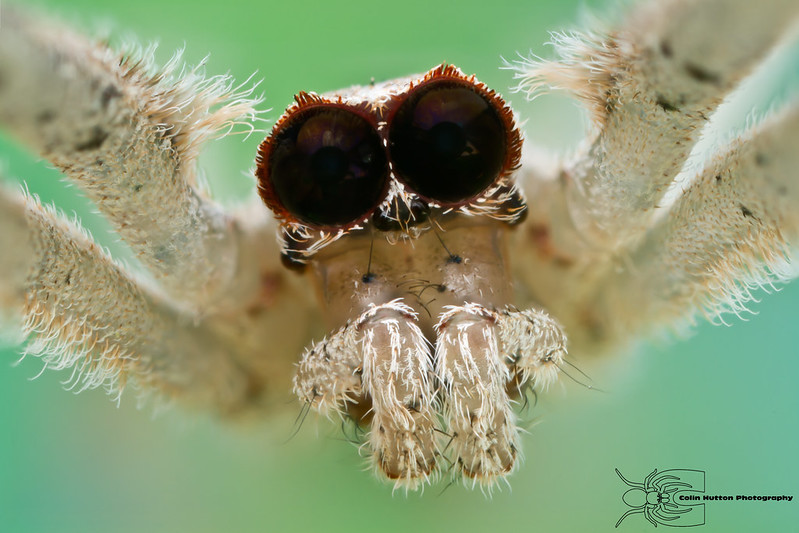
Ogre-Faced Spider


The spider family Deinopidae consists of stick-like elongate spiders that build
unusual webs that they suspend between the front legs. When prey approaches,
the spider will stretch the net to two or three times its relaxed size and propel
itself onto the prey, entangling it in the web. Because of this, they are also called
net-casting spiders.

Wednesday, January 2, 2013

A Star-Nosed Mole’s Nose


The star-nosed mole is easily identified by the 11 pairs of pink fleshy
appendages ringing its snout, which is used as a touch organ with more
than 25,000 minute sensory receptors, known as Eimer's organs, with
which this hamster-sized mole feels its way around. With the help of
its Eimer's organs, it may be perfectly poised to detect seismic wave
vibrations. Because the star-nosed mole is functionally blind, the snout
was long suspected to be used to detect electrical activity in prey
animals, though little, if any, empirical support has been found for
this hypothesis.

These moles also possess the ability to smell underwater, accomplished
by exhaling air bubbles onto objects or scent trails and then inhaling the
bubbles to carry scents back through the nose.

Photo by Kenneth Catania, National Geographic, October 2009

Wednesday, December 26, 2012

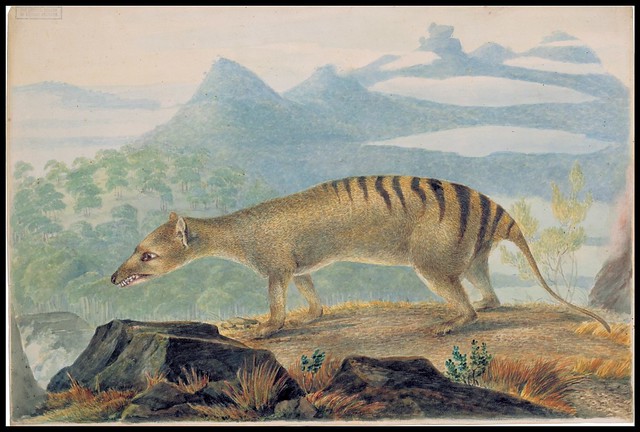
Tasmanian Tiger


 Thylacinus cynocephalus, Greek for "dog-headed pouched one", was the largest
 known carnivorous marsupial of modern times. It is commonly known as the
Tasmanian tiger (because of its striped back) or the Tasmanian wolf. Native to
continental Australia, Tasmania and New Guinea, it is thought to have become
extinct in the 20th century. It was the last extant member of its family, Thylacinidae;
specimens of other members of the family have been found in the fossil record
dating back to the early Miocene.

Despite its official classification as extinct, sightings are still reported, though none
has been conclusively proven. The thylacine was one of only two marsupials to have
a pouch in both sexes (the other being the water opossum). The male thylacine had
a pouch that acted as a protective sheath, covering the male's external reproductive
organs while he ran through thick brush. It has been described as a formidable predator
because of its ability to survive and hunt prey in extremely sparsely populated areas.
 
Source: http://en.wikipedia.org/wiki/Thylacine

Friday, November 30, 2012

Natural Selection Wins Again


A newly discovered Aphodiine Scarab from Cambodia is a stunning example
of how natural selection helps this termitophilic beetle adapt and find an easier
path to a meal.

The beetle not only tricks a colony of termites into granting it access to their
 stock pile of food by reproducing the scent of that food themselves, it also
 entices the termite to actually carry it directly to the food using the perfectly
sculpted handle on it's back.

Tuesday, November 20, 2012

Our Sun Erupts


On August 31, 2012 a long filament of solar material that had been hovering
in the sun’s atmosphere, the corona, erupted out into space at 4:36 p.m. EDT.
The coronal mass ejection, or CME, traveled at over 900 miles per second.
The CME did not travel directly toward Earth, but did connect with Earth’s
magnetic environment, or magnetosphere, causing aurora to appear on the night
 of Monday, September 3. The incredible image above is a lighten blended
version of the 304 and 171 angstrom wavelengths.

Source: Twisted Sifter

Willow the White Whale


 An extremely rare white humpback whale was spotted recently near Norway. 
Welsh maritime engineer Dan Fisher made the startling discovery off the coast
 of Norway in August.  Fisher has dubbed him Willow the White Whale. 

Website Life’s Little Mysteries states: this is only the second known adult white
 humpback whale on the planet. The first is Migaloo, a humpback who’s made 
numerous cameos off Australia’s east coast. The whale’s name means
 “white fella” in Aboriginal, and he’s usually spotted as he makes his annual 
migration to Antarctic waters during the southern spring. 

While Migaloo is thought to be affected by albinism, a genetic condition that 
stifles melanin pigmentation, it’s possible his Norwegian counterpart is not 
albino, but leucistic. Leucism can affect pigments other than melanin and it 
doesn’t result in the pink eyes characteristic of albinism. Leucism can also 
leave an animal with splotches of colour.

Source: Twisted Sifter

Monday, November 19, 2012

Proboscis Monkey


The proboscis monkey (Nasalis larvatus) or long-nosed monkey, known as the bekantan in Malay, is a reddish-brown arboreal Old World monkey that is endemic to the south-east Asian island of Borneo.

The monkey also goes by the Malay name monyet belanda ("Dutch monkey"), or even orang belanda ("Dutchman"), as Indonesians remarked that the Dutch colonisers often had a similarly large belly and nose.

Source: http://en.wikipedia.org/wiki/Proboscis_monkey

Friday, October 26, 2012

Dinosaurs Developed Feathers To Attract Mates, Not Fly


 In news that shouldn't surprise anyone who finds them so irresistible, paleontologists are now claiming that the earliest dinosaurs to develop feathers did so for courtship purposes and not to soar like giant, sexy eagles.

"They may have initially evolved as a secondary sexual characteristic," says a paper published Thursday in the prestigious journal Science.

 "Because they're in these large dinosaurs, (wings) haven't evolved for flight," Zelenitsky says. "(And) because these wing-like structures develop later in life, that suggests they were used for purposes like display or courtship or egg-brooding."

Tuesday, October 16, 2012


The defenceless newborns sitting under the vicious sting are the scorpion's own
offspring, tended by their mother until they are big enough to survive on their own.

Unlike most other arachnids they are viviparous: rather than laying eggs they give
birth to live young. The juveniles are unable to feed or defend themselves, or
regulate their moisture levels - they need their mother's protection.

Source: www.newscientist.com

Friday, September 21, 2012

Blue Footed Booby


 The Blue-footed Booby (Sula nebouxii) is a bird in the Sulidae family which comprises ten species of long-winged seabirds. The natural breeding habitat of the Blue-footed Booby is tropical and subtropical islands of the Pacific Ocean, most famously, the Galápagos Islands, Ecuador.

The courtship of the Blue-footed Booby consists of the male flaunting his blue feet and dancing to impress the female. During the dance, the male will spread his wings and stamp his feet on the ground.

Photo from: National Geographic

Tuesday, September 11, 2012

Hermit Crab Shells


The shells that hermit crabs seek are made by marine gastropods that secrete 
calcium carbonate from their mantel—the organ that covers their soft bodies. 
The shell is built up in deposits until the calcium carbonate becomes a crystalline
 structure held together via thin membranes of organic material. The univalve-type
 shells that hermit crabs prefer to adopt are spiral in shape. This formation 
affords the growing gastropod within the hard shell an ever-increasing area in
 which to expand.

 Hermit crabs are scavengers and often locate these borrowed dwellings by 
smell, when the original gastropod inhabitant dies and begins to decay. Once
 a hermit crab adopts a shell, it will keep it until the shell is outgrown, carrying 
it continuously as a shield, wherever it goes. In order to carry its home, one of 
the crab's front claws is completely dedicated to clutching the shell. This claw 
bends backward and holds on to the spool of calcium carbonate at the shell's 
center. In order to move, the animal must first use this claw to lift the shell and
 heave it onto its back. In spite of such difficulties, the drive to remain housed 
is so strong in this species that a typical hermit crab would rather be torn limb 
from limb than be pulled out of its shell. The only time that the animal will 
willingly leave its shell is a) if it locates another, more suitable one, or b) if it
 is shedding its exoskeleton—a process which can only be accomplished by 
fully exiting its dwelling just long enough to wriggle out of its own exfoliated 
shell casing.

When a hermit crab that has grown too large for its current home locates a new
 one, it determines the structure's suitability via a process called fondling. During
 this activity, the hermit crab will explore the shell's surface and its internal 
volume-to-weight ratio by rolling the shell over and gently rocking it back and
 forth. Since hermit crabs actually choose the shells that they inhabit, there is a 
large body of information concerning shell selection.

Source: www.cabinetmagazine.com

Wooly Bat and Carnivorous Plant Sybiosis


Professor Ulmar Grafe noticed that Hardwicke's woolly bats were regularly roosting in Nepenthes hemsleyana pitcher plants in Brunei (on the tropical island of Borneo).

 The benefits for the bats appears quite obvious, as this particular species of pitcher plant has a very low level of digestive fluid, meaning the bats can safely roost in an environment sheltered from predators and without fear of being eaten by enzymes.

Pitcher plants typically grow in areas where the soil is very nitrogen depleted, hence their reliance on a carnivorous life style.

Under further investigation Grafe found that the plants gained 33% of their nitrogen not from feeding on insects but from the droppings of the bats, showing strong evidence for an intriguing case of mutualism.

Source: Bat Conservation Intnl website www.batcon.org

Friday, September 7, 2012

The Transparent Glass Frog


 'Glass frog' is the common name of frogs in the amphibian family Centrolenidae. There are many species, and they are found throughout Central and South America.

As you can probably guess. their name comes from the obvious fact that many of the members of this family have translucent skin. Many internal organs including the heart, liver and gastrointestinal tract are visible.

Wednesday, September 5, 2012

Satanic Leaf-tailed Gecko


 "The stunning image of the species was captured at the Andasibe-Mantadia National Park in Madagascar. Satanic leaf-tailed geckos (Uroplatus phantasticus) can reach a total of length of 9cm, and its range is in the central eastern side of the African island."

 Source: www.dailymail.co.uk

Gecko vs. Lizard:
 Lizards are reptiles of the order Squamata, normally possessing four legs, external ear openings and movable eyelids. Geckos are small to average sized lizards belonging to the family Gekkonidae which are found in warm climates throughout the world. Geckos differ from other lizards in terms of their living conditions, physical charateristics and their eating habits

Source:  www.diffen.com