Showing posts with label mammal. Show all posts

Thursday, July 25, 2013

The Whole 2-Yards: Giraffe Neck Growth Patterns


The giraffe’s neck actually contains the same number of cervical (neck) vertebrae
found in nearly all other mammals. (For a discussion of the very few mammals
to deviate the magic number of seven cervicals, see this Endless Forms post).
The rate at which these vertebrae develop relative to other parts of the giraffe’s
body, including its head and overall body mass, however, has not been adequately
explored.

More at: www.scilogs.com/endless_forms

Wednesday, May 29, 2013

Thursday, February 7, 2013

Friday, February 1, 2013

Carnivorous Grasshopper Mouse


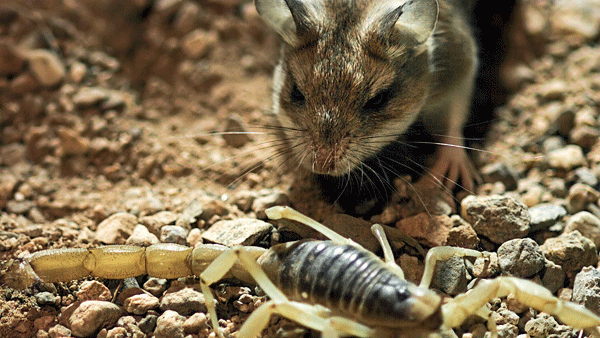
 It's the southern grasshopper mouse (Onychomys torridus), the only carnivorous
mouse in North America. Its unique biology and resistance to scorpion venom
may one day help researchers treat human pain disorders. But for now, it's just after blood.
Its behavior is rather distinct from other mice. It is a carnivorous rodent, dining
on insects (such as grasshoppers), worms, scorpions, snakes, and even other mice.
It also stalks its prey in the manner of a cat sneaking up quietly, and defends its
territory by "howling" like a small wolf.

Source: www.newscientist.com

Monday, January 28, 2013

Colugos


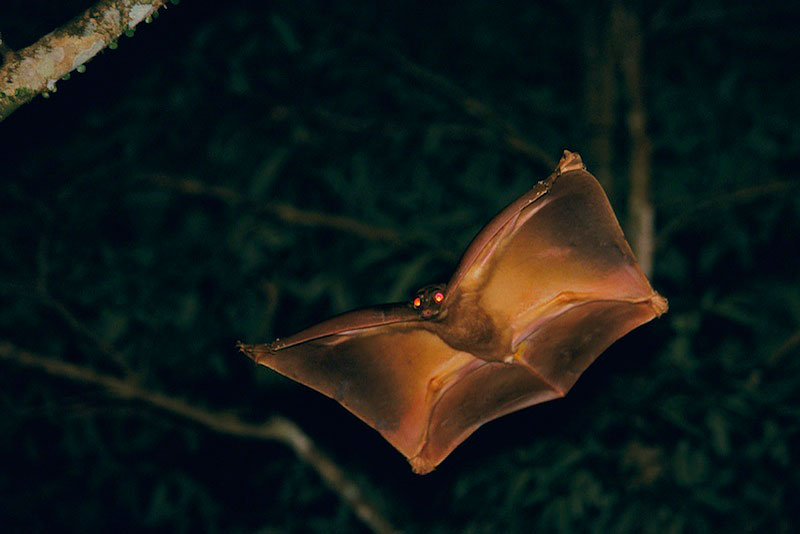
Colugos are arboreal gliding mammals found in South-east Asia. There are just
two extant species, which make up the entire family Cynocephalidae and order
Dermoptera. They are the most capable of all gliding mammals, using flaps of
extra skin between their legs to glide from higher to lower locations.
They are also known as cobegos or flying lemurs, though they are not true lemurs.

Colugos were traditionally considered being close to the ancestors of bats, but
are now seen by some as the closest living relatives to primates. 

Pen-tailed Tree Shrew Likes the Sauce


Malaysia's pen-tailed tree shrew (above) regularly drinks fermented palm "beer,"
which in turn helps pollinate the palms' flowers, scientists reported in July 2008.

The pen-tailed tree shrew is the first non-human mammal known to display
alcoholic behavior. What's more, the rat-size animal never gets drunk during
its nonstop jungle jamborees.

Since the tiny mammal is related to primate ancestors, the find also suggests humans'
taste for alcohol may have begun well before the believed advent of brewing about
9,000 years ago.

Source: http://news.nationalgeographic.com/news/bigphotos/30498685.html

Friday, January 18, 2013

Tuesday, November 27, 2012

Tuesday, November 20, 2012

Willow the White Whale


 An extremely rare white humpback whale was spotted recently near Norway. 
Welsh maritime engineer Dan Fisher made the startling discovery off the coast
 of Norway in August.  Fisher has dubbed him Willow the White Whale. 

Website Life’s Little Mysteries states: this is only the second known adult white
 humpback whale on the planet. The first is Migaloo, a humpback who’s made 
numerous cameos off Australia’s east coast. The whale’s name means
 “white fella” in Aboriginal, and he’s usually spotted as he makes his annual 
migration to Antarctic waters during the southern spring. 

While Migaloo is thought to be affected by albinism, a genetic condition that 
stifles melanin pigmentation, it’s possible his Norwegian counterpart is not 
albino, but leucistic. Leucism can affect pigments other than melanin and it 
doesn’t result in the pink eyes characteristic of albinism. Leucism can also 
leave an animal with splotches of colour.

Source: Twisted Sifter

Monday, November 19, 2012

Proboscis Monkey


The proboscis monkey (Nasalis larvatus) or long-nosed monkey, known as the bekantan in Malay, is a reddish-brown arboreal Old World monkey that is endemic to the south-east Asian island of Borneo.

The monkey also goes by the Malay name monyet belanda ("Dutch monkey"), or even orang belanda ("Dutchman"), as Indonesians remarked that the Dutch colonisers often had a similarly large belly and nose.

Source: http://en.wikipedia.org/wiki/Proboscis_monkey

Tuesday, November 6, 2012

Friday, September 28, 2012

Lionesses in South Africa


Taken at the Motswari Private Game Reserve in South Africa, we see two lionesses having a drink at a watering hole. On the right is a rare white lion from the Xakubasa Pride. The photograph was taken by the park’s ranger Chad Cocking.

Open to the Kruger National Park and playing host to Africa’s Big Five, the family-owned and operated Motswari Private Game Reserve is one of South Africa’s jewels nestled within the Timbavati Nature Reserve.

Tuesday, September 11, 2012

Wooly Bat and Carnivorous Plant Sybiosis


Professor Ulmar Grafe noticed that Hardwicke's woolly bats were regularly roosting in Nepenthes hemsleyana pitcher plants in Brunei (on the tropical island of Borneo).

 The benefits for the bats appears quite obvious, as this particular species of pitcher plant has a very low level of digestive fluid, meaning the bats can safely roost in an environment sheltered from predators and without fear of being eaten by enzymes.

Pitcher plants typically grow in areas where the soil is very nitrogen depleted, hence their reliance on a carnivorous life style.

Under further investigation Grafe found that the plants gained 33% of their nitrogen not from feeding on insects but from the droppings of the bats, showing strong evidence for an intriguing case of mutualism.

Source: Bat Conservation Intnl website www.batcon.org